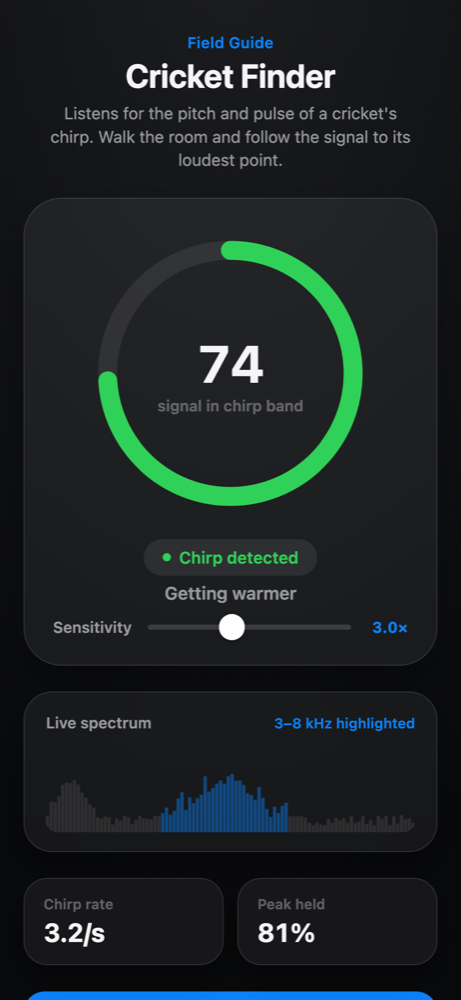
Listen and zero in on that annoying cricket in your house.
import Foundation

/// A 3D LUT. `data` holds RGB triplets with red varying fastest, then green, then blue (the .cube order).
public struct LUT3D: Equatable, Sendable {
    public var size: Int
    public var data: [Float]
    public var domainMin = Vec3(0, 0, 0)
    public var domainMax = Vec3(1, 1, 1)
    public var title: String = ""

    public init(size: Int, data: [Float]) {
        precondition(data.count == size * size * size * 3)
        self.size = size; self.data = data
    }

    public static func identity(size: Int) -> LUT3D { bake(size: size) { $0 } }

    /// Evaluate `f` at every grid point.
    public static func bake(size n: Int, _ f: (Vec3) -> Vec3) -> LUT3D {
        var d = [Float](repeating: 0, count: n * n * n * 3)
        let s = 1.0 / Double(n - 1)
        var i = 0
        for b in 0..<n { for g in 0..<n { for r in 0..<n {
            let o = f(Vec3(Double(r) * s, Double(g) * s, Double(b) * s))
            d[i] = Float(o.x); d[i + 1] = Float(o.y); d[i + 2] = Float(o.z); i += 3
        } } }
        return LUT3D(size: n, data: d)
    }

    @inline(__always) private func at(_ r: Int, _ g: Int, _ b: Int) -> Vec3 {
        let i = ((b * size + g) * size + r) * 3
        return Vec3(Double(data[i]), Double(data[i + 1]), Double(data[i + 2]))
    }

    /// Tetrahedral interpolation (the method Resolve uses).
    public func sample(_ v: Vec3) -> Vec3 {
        let m = Double(size - 1)
        func coord(_ x: Double, _ lo: Double, _ hi: Double) -> (Int, Double) {
            let t = min(max((x - lo) / (hi - lo), 0), 1) * m
            let i = min(Int(t), size - 2)
            return (i, t - Double(i))
        }
        let (r0, fr) = coord(v.x, domainMin.x, domainMax.x)
        let (g0, fg) = coord(v.y, domainMin.y, domainMax.y)
        let (b0, fb) = coord(v.z, domainMin.z, domainMax.z)
        let c000 = at(r0, g0, b0), c111 = at(r0 + 1, g0 + 1, b0 + 1)
        if fr > fg {
            if fg > fb {
                let c100 = at(r0 + 1, g0, b0), c110 = at(r0 + 1, g0 + 1, b0)
                return c000 * (1 - fr) + c100 * (fr - fg) + c110 * (fg - fb) + c111 * fb
Mac · iPhone · Colour
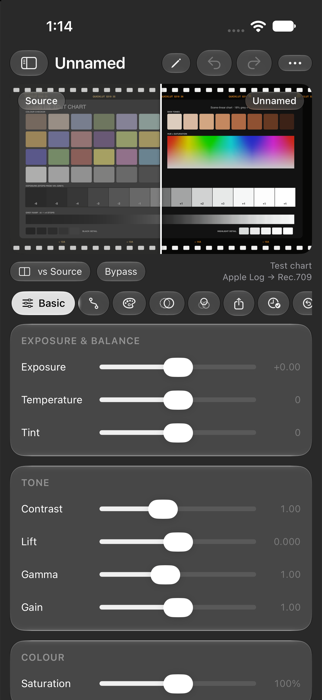
QuickLUT
Build camera LUTs for Apple Log footage, preview the grade live, and export .cube files and graded clips.
import Foundation
import CoreMediaIO
import CoreMedia
import CoreVideo

/// Pushes frames into the Camera Extension's sink stream (the extension republishes them as the "DSLR Connect" camera).
final class SinkSender {
    static let deviceUID = "D51C0A11-7B3E-4F52-9C1A-0E5D2B5D3001"
    static let sinkName = "DSLR Connect.Sink"

    private let lock = NSLock()
    private var deviceID: CMIODeviceID = 0
    private var streamID: CMIOStreamID = 0
    private var queue: CMSimpleQueue?
    private var lastAttempt = Date.distantPast
    private var failedEnqueues = 0
    private var loggedMissing = false
    private var loggedFirstSend = false

    /// Lets CoreMediaIO deliver device add/remove notifications to this process, so a camera extension that is
    /// installed or approved while the app is running shows up without restarting the app.
    static func enableDeviceNotifications() {
        var a = address(0x726E6C70) // kCMIOHardwarePropertyRunLoop ('rnlp')
        var runLoop = CFRunLoopGetMain()
        let st = CMIOObjectSetPropertyData(CMIOObjectID(kCMIOObjectSystemObject), &a, 0, nil,
                                           UInt32(MemoryLayout<CFRunLoop?>.size), &runLoop)
        if st != noErr { logLine("sink: could not set CoreMediaIO run loop (\(st))") }
    }

    private var loggedViewerFormat = false

    /// How many apps are currently reading the camera, or nil if that can't be determined.
    func viewerCount() -> Int? {
        lock.lock(); defer { lock.unlock() }
        guard queue != nil else { return nil }
        var a = Self.address(0x76777273)  // 'vwrs'
        guard CMIOObjectHasProperty(deviceID, &a) else { return nil }
        var size: UInt32 = 0
        guard CMIOObjectGetPropertyDataSize(deviceID, &a, 0, nil, &size) == noErr, size >= 4 else { return nil }
        var buf = [UInt8](repeating: 0, count: Int(size))
        var used: UInt32 = 0
        guard CMIOObjectGetPropertyData(deviceID, &a, 0, nil, size, &used, &buf) == noErr else { return nil }
Mac app · Camera extension · Website
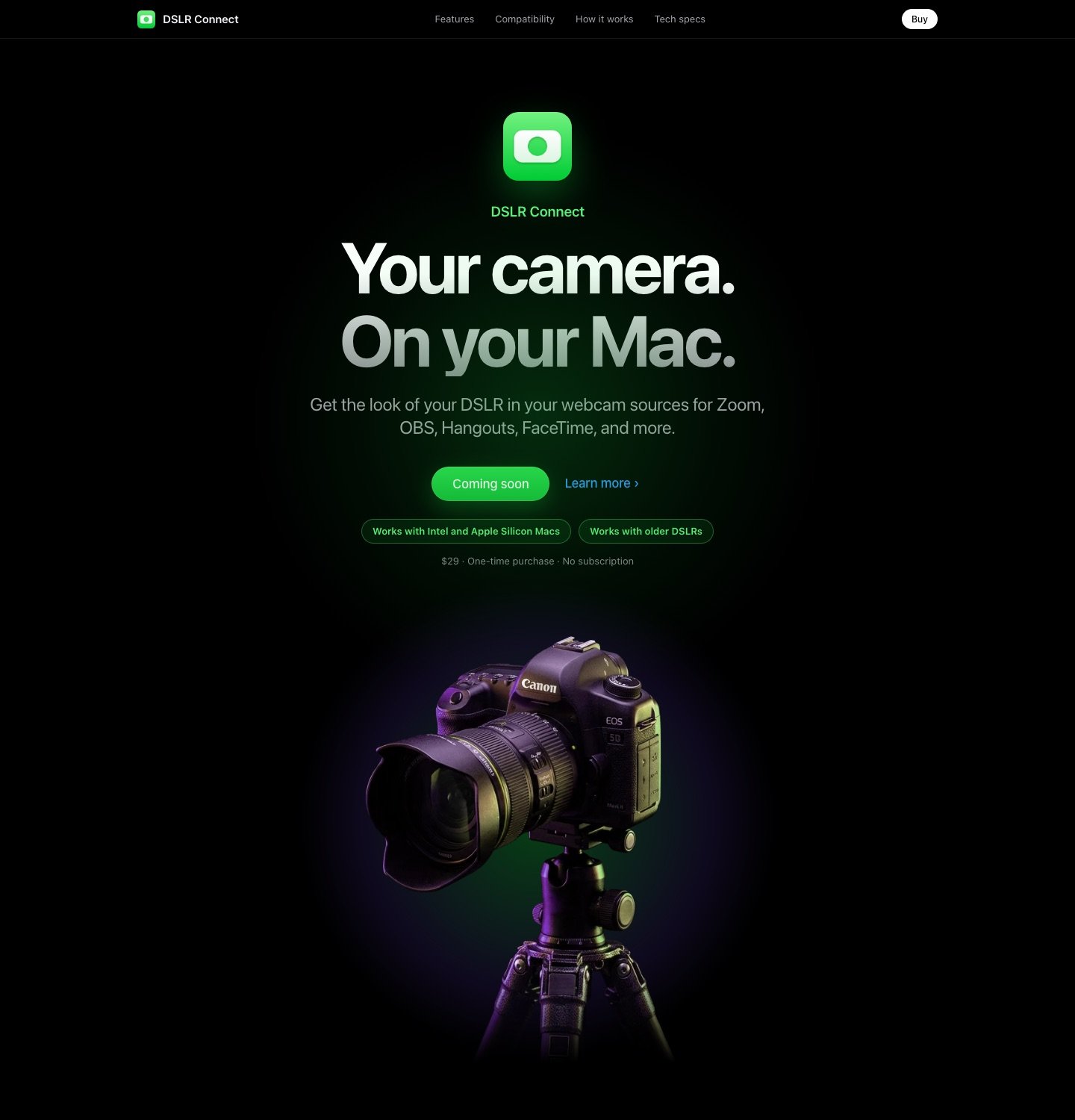
DSLR Connect
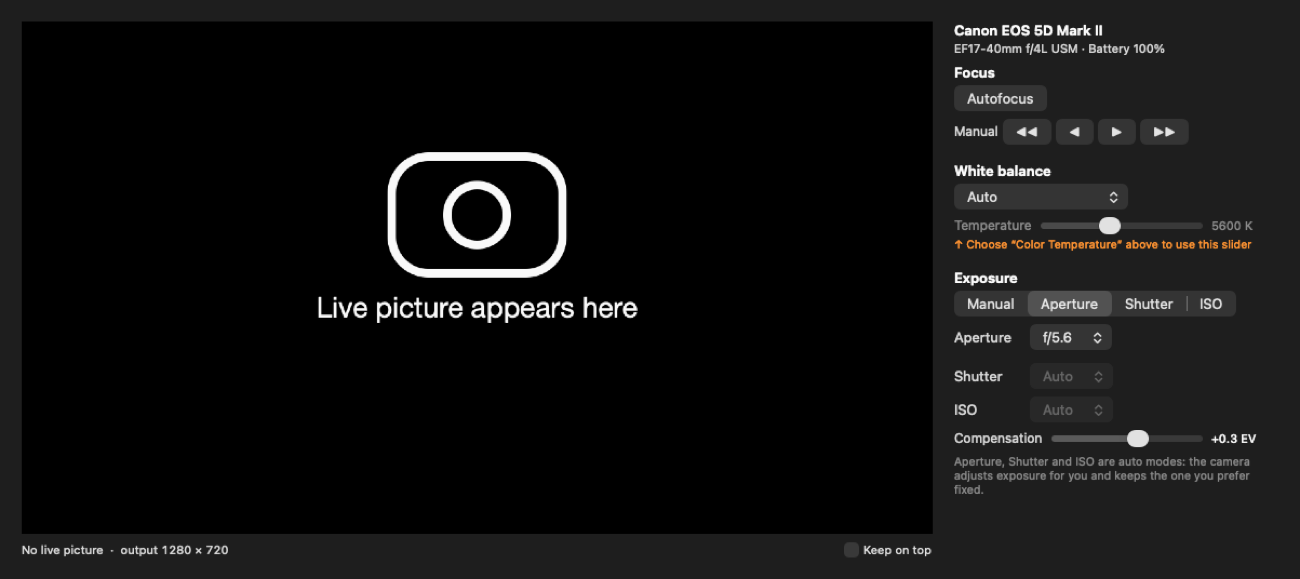
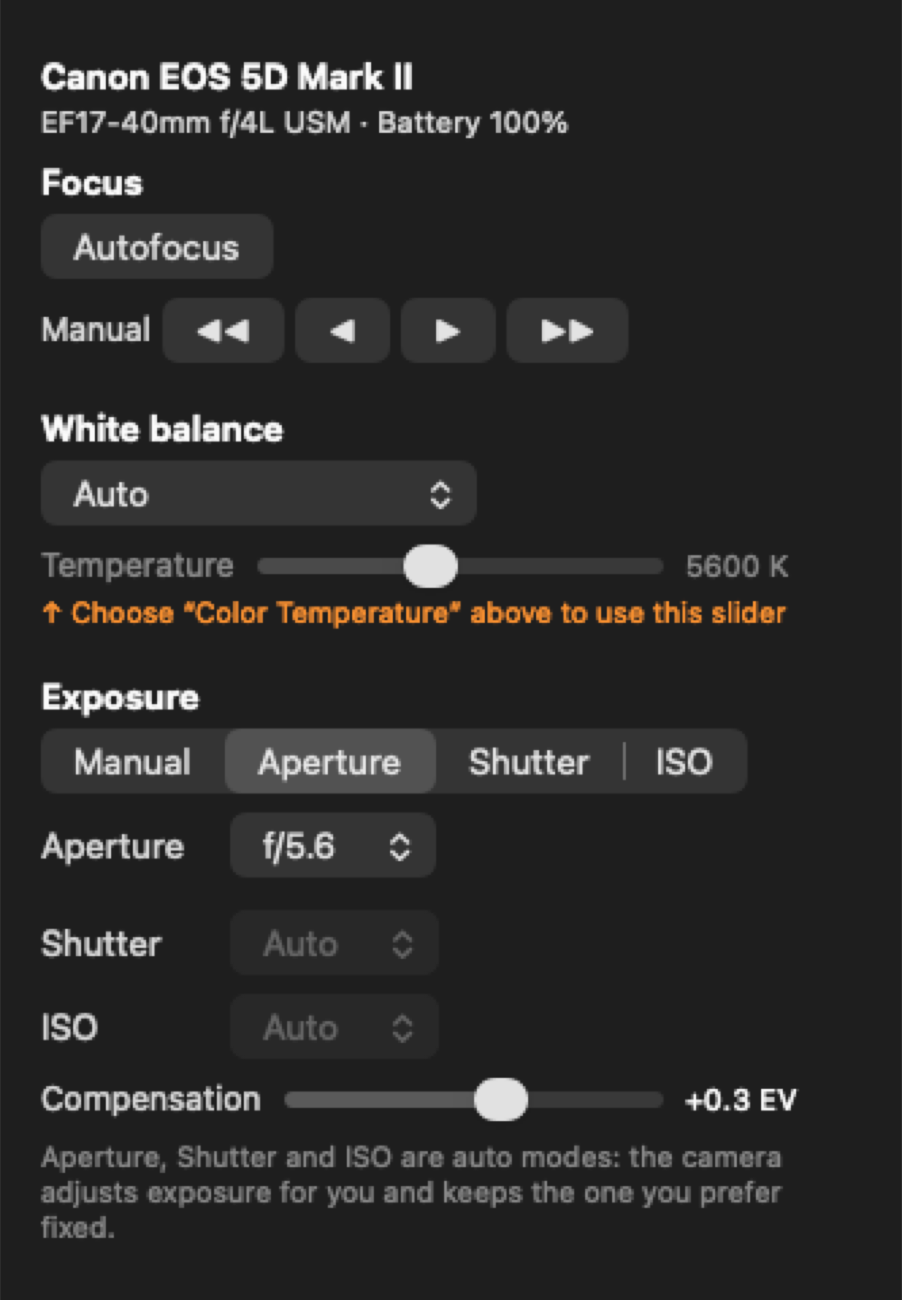
Turns a DSLR into a webcam for Zoom, FaceTime and OBS, with a native menu-bar app and a virtual camera.
The craft behind it.
Logos, book covers, maps, product shoots and motion — and the tools I make it all with.